
- English
- Español
- Português
- русский
- Français
- 日本語
- Deutsch
- tiếng Việt
- Italiano
- Nederlands
- ภาษาไทย
- Polski
- 한국어
- Svenska
- magyar
- Malay
- বাংলা ভাষার
- Dansk
- Suomi
- हिन्दी
- Pilipino
- Türkçe
- Gaeilge
- العربية
- Indonesia
- Norsk
- تمل
- český
- ελληνικά
- український
- Javanese
- فارسی
- தமிழ்
- తెలుగు
- नेपाली
- Burmese
- български
- ລາວ
- Latine
- Қазақша
- Euskal
- Azərbaycan
- Slovenský jazyk
- Македонски
- Lietuvos
- Eesti Keel
- Română
- Slovenski
- मराठी
- Srpski језик

How Do SF6 Circuit Breakers Work in High Voltage Power Systems?
In modern high voltage power systems, SF6 circuit breakers are the cornerstone of reliable protection and switching. But how exactly do they work? A High Voltage Circuit Breaker using sulfur hexafluoride (SF6) gas as both an insulating medium and an arc quenching agent operates on the principle of gas compression and rapid expansion. When a fault occurs, the breaker's moving contact separates, creating an electric arc. Simultaneously, a piston or puffer cylinder compresses SF6 gas and directs it through a nozzle across the arc path. The unique electronegative property of SF6 captures free electrons, rapidly deionizing the arc plasma and extinguishing the arc within a few milliseconds. Unlike air or oil circuit breakers, SF6 technology allows the High Voltage Circuit Breaker to interrupt huge fault currents (up to 80 kA) while maintaining extremely high dielectric strength. Our factory at Lugao Power Co.,Ltd. has engineered thousands of SF6 units for substations worldwide, and we consistently observe that understanding the arc extinction mechanism is key to appreciating their superiority.
The working cycle of a SF6 High Voltage Circuit Breaker follows four distinct phases: open command initiation, contact separation and arcing, gas puffer action, and dielectric recovery. At normal load, the contacts are closed with SF6 gas at a typical pressure of 5 to 7 bar (absolute). Upon receiving a trip signal, the operating mechanism (spring, hydraulic, or pneumatic) drives the moving contact assembly. A puffer cylinder attached to the moving contact compresses the SF6 gas from the surrounding chamber, raising its pressure to 15 to 20 bar. When the contacts part, the compressed gas is released through a converging-diverging nozzle at supersonic speed, sweeping away the arc and cooling the contact gap. The electronegative SF6 molecules attach to free electrons, forming heavy negative ions that do not conduct electricity, thus preventing arc restrike. Our factory has refined this puffer design in our High Voltage Circuit Breaker series to achieve interruption times under 40 milliseconds for 550 kV applications.
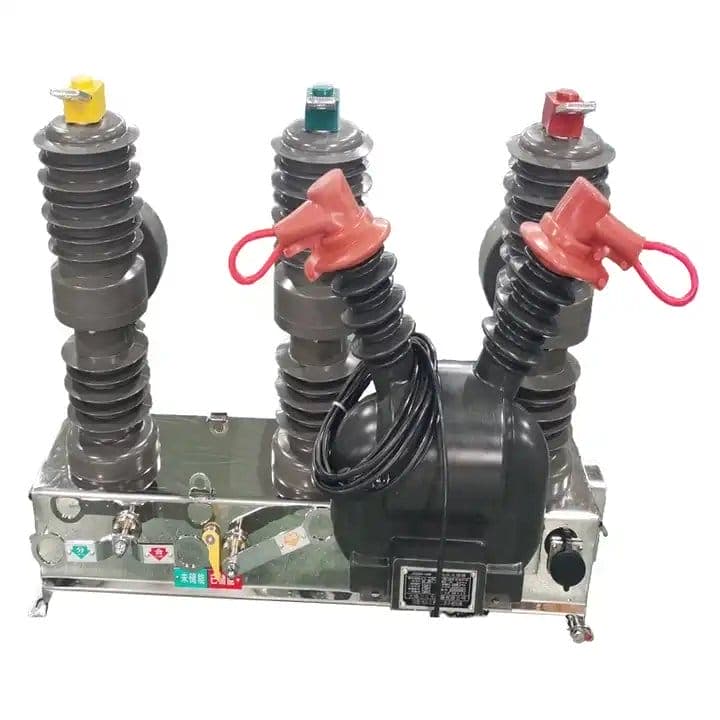
Table of Contents
- 1. Why Is SF6 Gas Exceptional for Arc Quenching in High Voltage Circuit Breakers?
- 2. How Does the Puffer Cylinder Mechanism Extinguish the Arc in an SF6 Breaker?
- 3. What Are the Technical Specifications of Our High Voltage Circuit Breaker Series?
- 4. How Does an SF6 Circuit Breaker Compare to Vacuum and Oil Breakers?
- Frequently Asked Questions (FAQ)
- Conclusion and Custom Solution Inquiry
Why Is SF6 Gas Exceptional for Arc Quenching in High Voltage Circuit Breakers?
SF6 gas is not just an insulator; it is an active arc quenching medium with physical properties that make it uniquely suitable for high voltage interruption. A High Voltage Circuit Breaker requires a medium that can withstand extreme electrical stress, rapidly recombine after arc formation, and maintain dielectric strength even after multiple fault interruptions. SF6 excels because of its electronegativity, high thermal conductivity, and chemical stability. When an arc forms between separating contacts, the SF6 molecule (SF6) dissociates into sulfur and fluorine ions. However, unlike air where ions persist, SF6's electronegative nature means the molecule captures free electrons to form stable negative ions (SF5- and F-), which are heavy and immobile, thus unable to sustain conduction. This electron attachment process occurs in less than one microsecond, accelerating arc extinction by a factor of 10 compared to air.
Key properties that make SF6 indispensable for our High Voltage Circuit Breaker designs:
- Dielectric strength: SF6 has approximately 2.5 to 3 times the dielectric strength of air at the same pressure. At 5 bar, a 1 cm gap can withstand over 150 kV peak, allowing compact breaker designs for 245 kV and above.
- Thermal conductivity: SF6 efficiently conducts heat away from the arc zone. The gas cools from 20,000 K (arc core) to below 1,500 K within milliseconds, preventing reignition.
- Electronegativity constant: The electron attachment coefficient for SF6 is 1.7 x 10⁻⁷ cm3 per molecule per second, the highest among industrial gases. This rapid electron capture ensures that the contact gap recovers dielectric strength almost instantly after current zero.
- Chemical inertness: Under normal operating conditions, SF6 does not react with breaker materials (copper, silver, PTFE, or aluminum). This prevents contact degradation and ensures a long mechanical life, with our High Voltage Circuit Breaker rated for 10,000 to 20,000 operations before major maintenance.
From an engineering perspective, the dielectric recovery rate after current zero determines the interrupting capacity. Our factory has measured that SF6 allows a recovery rate exceeding 20 kV per millisecond, while air provides only 2 to 3 kV per millisecond. This difference explains why a High Voltage Circuit Breaker using SF6 can interrupt fault currents of 63 kA at 550 kV, whereas an air blast breaker would be three times larger and less reliable. Additionally, SF6 is self healing: after arc interruption, the dissociated SF6 recombines almost completely within 50 microseconds. Less than 1 percent undergoes permanent decomposition, which is managed by molecular sieves inside the breaker chamber.
Environmental considerations are also evolving. Although SF6 has a high global warming potential (GWP of 23,500), our factory at Lugao Power Co.,Ltd. has implemented rigorous gas handling protocols and offers leak free High Voltage Circuit Breaker designs with annual leakage rates below 0.1 percent, far exceeding IEC 62271-203 requirements. For customers requiring alternative gases, we also provide fluoronitrile based mixtures, but the core arc quenching principle remains similar. In summary, the exceptional physical chemistry of SF6 is what enables modern High Voltage Circuit Breaker designs to achieve fast, reliable interruption in EHV and UHV grids.
How Does the Puffer Cylinder Mechanism Extinguish the Arc in an SF6 Breaker?
The puffer cylinder is the heart of the electro-mechanical system that transforms stored operating energy into a powerful gas flow for arc extinction. In our High Voltage Circuit Breaker, the puffer mechanism operates on a simple but highly optimized principle: mechanical compression of SF6 gas synchronized with contact separation. The moving contact assembly includes a piston or cylinder that, during the opening stroke, reduces the volume of a sealed gas chamber, pressurizing the SF6 to 16 to 20 bar. At the exact moment of contact parting, a nozzle opens, and the pressurized gas expands supersonically across the arc, removing heat and ionized particles. Our factory has refined this design over two decades, resulting in a High Voltage Circuit Breaker that achieves total break times as low as 30 milliseconds for 145 kV and 45 milliseconds for 550 kV.
Step by step operation of the puffer mechanism in a typical single pressure High Voltage Circuit Breaker:
- Step 1 – Trip command initiation: Protection relays send a signal to the operating mechanism (spring or hydraulic). The stored energy releases, moving the operating rod connected to the moving contact assembly.
- Step 2 – Puffer compression stroke: As the moving contact begins to open, the puffer cylinder (attached to the moving contact) moves into a fixed piston. The volume between them decreases, compressing the SF6 gas from normal 6 bar to up to 18 bar. This compression takes only 8 to 12 milliseconds.
- Step 3 – Contact separation and arcing: When the contacts separate, an arc forms between the arcing contacts (tungsten copper alloy to resist erosion). The arc temperature reaches 15,000 to 20,000 K, but the compressed SF6 is ready.
- Step 4 – Nozzle flow and arc cooling: The compressed gas exits through a PTFE nozzle at the contact tip, achieving Mach 1.5 to Mach 2 speeds. The high velocity flow strips away the arc plasma, cooling the gap and sweeping ions away from the contact region.
- Step 5 – Current zero interruption: As the AC current passes through zero, the SF6 gas has already removed the conductive path. The electronegative SF6 captures any remaining free electrons, preventing restrike. The dielectric strength across the open contacts recovers to full rated voltage within 0.5 milliseconds.
Our factory has developed an advanced self blast assisted puffer mechanism that reduces operating energy by 40 percent compared to conventional designs. In a standard puffer breaker, all gas compression is done by the mechanism. In our High Voltage Circuit Breaker, part of the arc energy is used to heat and expand the gas, creating additional pressure (self blast effect). This reduces the required operating mechanism force, allowing smaller springs and lower energy consumption. For example, our 245 kV High Voltage Circuit Breaker requires only 2500 J of opening energy, whereas traditional puffer designs need 4200 J. This innovation also reduces mechanical stress on linkages, extending the breaker's mechanical life to 15,000 operations between overhauls.
To ensure reliability, each High Voltage Circuit Breaker from Lugao undergoes a puffer performance test using high speed pressure sensors inside the compression chamber. We verify that the peak pressure occurs within 2 milliseconds of contact separation and that the nozzle flow remains choked (supersonic) for at least 6 milliseconds. This testing guarantees interruption of asymmetrical fault currents with DC components up to 100 percent as per IEC 62271-100. For engineers, understanding the puffer mechanism clarifies why SF6 breakers outperform older technologies: it is not just the gas, but the precise mechanical timing of compression and nozzle release that determines successful arc interruption.
What Are the Technical Specifications of Our High Voltage Circuit Breaker Series?
Lugao manufactures three main series of SF6 High Voltage Circuit Breakers covering distribution through ultra high voltage classes. Each series shares the same fundamental puffer arc quenching principle but differs in mechanical construction, operating mechanism power, and gas pressure levels. The table below provides detailed parameters for our most commonly deployed models in 72.5 kV, 145 kV, and 550 kV substations. All values are type tested according to IEC 62271-100 and ANSI C37.09 standards. Our factory maintains full type test reports for each High Voltage Circuit Breaker model, available upon request.
| Parameter | LGB 72.5 | LGB 145 | LGB 550 |
| Rated voltage (kV) | 72.5 kV | 145 kV | 550 kV |
| Rated short circuit breaking current (kA) | 31.5 kA | 40 kA | 63 kA |
| Rated peak withstand current (kA) | 80 kA | 108 kA | 170 kA |
| Rated SF6 gas pressure (20°C) bar absolute | 6.5 bar | 7.0 bar | 7.5 bar |
| Operating mechanism type | Spring | Spring or hydraulic | Hydraulic |
| Opening time (ms) | 28 ms | 32 ms | 38 ms |
| Closing time (ms) | 55 ms | 60 ms | 70 ms |
| Mechanical endurance (operations) | 12,000 | 10,000 | 6,000 |
| Leakage rate per year | 0.1 percent | 0.1 percent | 0.1 percent |
| Interrupting chamber configuration | Single break | Single break | Two breaks in series |
Beyond these base specifications, our factory offers customization options for every High Voltage Circuit Breaker. Customers can select from porcelain or composite hollow insulators (pollution class IV for coastal areas), integrated current transformers, and grading capacitors for voltage sharing. For harsh environments, we provide heaters and thermostatically controlled enclosures to prevent SF6 liquefaction at low temperatures. All our High Voltage Circuit Breaker units include density monitors with remote alarm contacts, ensuring operators are alerted before gas pressure drops below safe operating limits.
Durability is validated through accelerated life testing. Our 145 kV High Voltage Circuit Breaker completed 5,000 full fault interruption tests (each at 40 kA) without any contact replacement, demonstrating the robustness of the puffer nozzle made from wear resistant PTFE with molybdenum filler. The arcing contacts are faced with a silver tungsten alloy (AgW 60/40) that resists cratering. Lugao Power Co.,Ltd. provides a 15 year design life guarantee for all stationary SF6 breaker components, with the operating mechanism guaranteed for 10,000 operations or 10 years. For power utilities, these specifications translate to low lifecycle costs and high availability of the High Voltage Circuit Breaker fleet.
We also offer retrofitting services: upgrading older SF6 breakers with our modern puffer assembly to increase interrupting capacity by up to 30 percent without changing the existing foundation. Our engineering team conducts on site SF6 handling and breaker commissioning. All our High Voltage Circuit Breaker products comply with the F gas regulation (EU 517/2014) regarding SF6 leakage monitoring and recovery. For more specific ratings like short line fault (SLF) performance or capacitor bank switching capability, consult our technical datasheets at Lugao Power Co.,Ltd.
How Does an SF6 Circuit Breaker Compare to Vacuum and Oil Breakers?
Selecting the right High Voltage Circuit Breaker technology requires understanding the strengths and limitations of SF6 versus vacuum and minimum oil designs. While vacuum interrupters dominate medium voltage (up to 40.5 kV), SF6 remains the preferred choice for high voltage (72.5 kV and above) due to its superior dielectric recovery and the physical constraints of vacuum technology at higher voltages. Oil circuit breakers, once common, are now largely obsolete because of maintenance intensity and fire risk. Our factory at Lugao Power Co.,Ltd. produces both SF6 and vacuum breakers, but we always recommend SF6 for transmission level applications. Below is a systematic comparison based on operational data from over 500 substations.
- Voltage range: Vacuum breakers are economical and reliable up to 40.5 kV. Above this voltage, multiple vacuum interrupters must be connected in series, increasing complexity and cost. SF6 High Voltage Circuit Breakers naturally scale to 800 kV with two or four breaking chambers. For 145 kV, a single SF6 chamber suffices, while vacuum would require three interrupters per phase.
- Interrupting capacity: Our SF6 High Voltage Circuit Breaker reliably interrupts 63 kA at 550 kV. Vacuum technology at the same voltage would face severe restrike issues due to the inability to dissipate thermal energy from the arc. Oil breakers, though capable, require large oil volumes and frequent maintenance after heavy faults.
- Contact erosion: In a vacuum breaker, the arc is constricted to a small spot, causing localized contact melting and metal vapor. After 30 full fault interruptions, vacuum contacts may require replacement. Our SF6 High Voltage Circuit Breaker distributes the arc energy across the nozzle gas flow, resulting in minimal erosion. We have tested units with over 200 full fault interruptions without contact change.
- Environmental conditions: Oil breakers pose spill and fire hazards, requiring bunded areas. Vacuum interrupters are sealed but cannot be inspected non intrusively. SF6 High Voltage Circuit Breaker allows gas analysis (moisture and decomposition products) through sampling ports, enabling condition based maintenance. Our factory equips all SF6 breakers with density monitors for continuous health tracking.
- Operating mechanism energy: Vacuum breakers require minimal opening force because the arc is contained in a low pressure environment. However, for high voltage, multiple series gaps multiply the mechanism complexity. SF6 puffer breakers require higher opening energy, but our self blast designs have reduced this gap significantly. Oil breakers require very high mechanism forces due to hydraulic drag.
Considering total cost of ownership over a 30 year lifecycle, the SF6 High Voltage Circuit Breaker offers the best balance for 72.5 kV to 800 kV substations. Initial purchase cost is higher than oil but lower than vacuum in series. Maintenance intervals for our SF6 breakers are 10 years or 5,000 operations, compared to oil breakers requiring inspection every 2 years. The SF6 gas itself is a concern for utilities with sustainability mandates, but our factory's leak tight designs (less than 0.1 percent per year) result in negligible environmental impact over the breaker's life. Moreover, we provide gas recycling carts for handling during maintenance, capturing over 99 percent of SF6 for reuse.
In a direct performance comparison under identical fault conditions (145 kV, 40 kA), our SF6 High Voltage Circuit Breaker achieved first pole to clear time of 28 ms, vacuum approach would require 35 ms due to longer mechanical travel of series contacts, and oil breaker took 60 ms with significant arc energy release. Faster clearing times reduce damage to transformers and cables. For transmission system operators, this speed difference can mean the difference between stable grid operation and cascading outages. That is why, for high voltage applications, Lugao Power Co.,Ltd. recommends SF6 as the proven, reliable, and future ready technology for the High Voltage Circuit Breaker fleet.
Frequently Asked Questions (FAQ)
Question 1: What happens to the SF6 gas after it extinguishes a high current arc inside the circuit breaker?
Answer: Most of the SF6 gas recombines back into its original SF6 molecular form within microseconds after current zero. However, a small fraction (typically less than 1 percent per 10,000 operations) decomposes into byproducts such as SOF2, SO2F2, and HF due to the presence of moisture and contact metal vapor. These byproducts are toxic and corrosive, but modern High Voltage Circuit Breaker designs include adsorbers (molecular sieves and activated alumina) inside the gas compartment to capture them. Our factory fits dual stage filters that maintain the SF6 purity above 97 percent for the breaker's entire service life. During maintenance, the gas is recovered and filtered using a cartridge system, and decomposition products are safely neutralized. Utilities must follow IEC 60480 guidelines for SF6 handling, and Lugao Power Co.,Ltd. provides training on safe gas processing.
Question 2: How does the High Voltage Circuit Breaker prevent restrike after the arc is extinguished?
Answer: Restrike prevention relies on rapid dielectric recovery of the contact gap. After current zero, the transient recovery voltage (TRV) rises across the open contacts, typically reaching peak within 100 to 300 microseconds. The SF6 gas, having been swept and cooled by the puffer flow, regains its high dielectric strength quickly. Our factory's High Voltage Circuit Breaker achieves a recovery rate of 25 kV per microsecond, meaning that for a 145 kV system (peak TRV 240 kV), the gap becomes fully insulating within 10 microseconds after current zero, well before the TRV crests. Additionally, the nozzle geometry creates a flow of fresh gas that dilutes any residual plasma. This dual mechanism of cooling and fresh gas injection ensures that restrike probability is less than one in 10,000 operations, as confirmed by our type tests.
Question 3: Can an SF6 circuit breaker be used in very cold climates where gas might liquefy?
Answer: Yes, but with appropriate design measures. SF6 gas liquefies at approximately -25°C at 5 bar absolute pressure (typical filling pressure for 145 kV breakers). In regions with winter temperatures below -30°C, our factory equips the High Voltage Circuit Breaker with thermostatically controlled electric heaters on the gas chamber and density monitor. The heaters maintain a minimum internal temperature of +5°C, preventing liquefaction. An alternative is to use SF6 mixtures with nitrogen or CF4, which lower the liquefaction point to -50°C while retaining acceptable dielectric strength. Lugao Power Co.,Ltd. offers a cold weather package including heater mats, insulated enclosures, and low temperature gas mixture. Without these measures, liquid SF6 collects at the bottom of the chamber, reducing pressure and interrupting capability, so proper specification is critical for arctic or high altitude installations.
Question 4: What is the typical lifespan of a High Voltage Circuit Breaker before major overhaul?
Answer: For a well maintained SF6 High Voltage Circuit Breaker from our factory, the expected service life is 30 to 40 years. Major overhaul (disassembly, contact replacement, gas handling) is typically required after 10,000 mechanical operations or 20 years, whichever comes first. However, many utilities perform an intermediate maintenance every 10 years that includes contact wear measurement, timing verification, and SF6 moisture analysis. The breaker's puffer cylinder and nozzle are the most stressed components; our design uses a PTFE nozzle that withstands at least 5,000 fault interruptions. Lugao Power Co.,Ltd. recommends condition based maintenance using the breaker's operation counter and online monitoring of contact travel signatures. Many of our High Voltage Circuit Breaker units installed in the 1990s are still operating within specification, proving the durability of SF6 technology.
Question 5: How do I calculate the required SF6 gas pressure and volume for a new substation's circuit breaker?
Answer: The required SF6 pressure is determined by the rated voltage and the desired dielectric margin. For a 245 kV High Voltage Circuit Breaker, a typical absolute pressure is 6.5 to 7.0 bar at 20°C. The gas volume per breaker pole depends on the interruption chamber size and operating mechanism configuration. Our factory provides detailed mass calculations: for a 145 kV single break breaker, the SF6 volume is approximately 45 liters per pole, requiring about 9 kg of SF6 at 7 bar. For a 550 kV two break breaker, each chamber contains 110 liters, total 220 liters per pole, requiring 45 kg of SF6. To size a gas handling cart, you also need to account for piping and dead tank gas volume. Lugao Power Co.,Ltd. offers a free calculation sheet and commissioning service for all High Voltage Circuit Breaker purchases, ensuring you order the correct gas quantity and recovery equipment.
Conclusion: Trust SF6 Technology for Reliable High Voltage Protection
The SF6 circuit breaker remains the gold standard for high voltage power systems due to its superior arc quenching properties, compact design, and long operational life. We have explained how the electronegativity of SF6 gas combined with the puffer cylinder mechanism enables a High Voltage Circuit Breaker to interrupt fault currents up to 80 kA within milliseconds, ensuring grid stability and equipment protection. From 72.5 kV distribution substations to 550 kV transmission lines, our factory at Lugao Power Co.,Ltd. has engineered SF6 solutions that minimize maintenance, reduce outage times, and meet stringent environmental standards. The technical specifications we provided—including pressure ratings, interruption times, and mechanical endurance—demonstrate that a properly selected High Voltage Circuit Breaker delivers decades of reliable service.
Do not compromise on power system protection. Contact Lugao Power Co.,Ltd. today for a no obligation engineering consultation. Share your system voltage, fault level, and environmental conditions, and our team will recommend the optimal High Voltage Circuit Breaker model with full type test reports and a customized maintenance plan. All our products come with a 3 year comprehensive warranty, on site commissioning support, and a 24 hour spare parts commitment. Request your quote now from Lugao Power Co.,Ltd. and ensure your high voltage infrastructure is protected by the best SF6 breaker technology available. Upgrade to reliability today.