
- English
- Español
- Português
- русский
- Français
- 日本語
- Deutsch
- tiếng Việt
- Italiano
- Nederlands
- ภาษาไทย
- Polski
- 한국어
- Svenska
- magyar
- Malay
- বাংলা ভাষার
- Dansk
- Suomi
- हिन्दी
- Pilipino
- Türkçe
- Gaeilge
- العربية
- Indonesia
- Norsk
- تمل
- český
- ελληνικά
- український
- Javanese
- فارسی
- தமிழ்
- తెలుగు
- नेपाली
- Burmese
- български
- ລາວ
- Latine
- Қазақша
- Euskal
- Azərbaycan
- Slovenský jazyk
- Македонски
- Lietuvos
- Eesti Keel
- Română
- Slovenski
- मराठी
- Srpski језик

What Is the Difference Between Gas-Insulated and Air-Insulated Ring Main Units?
When selecting medium voltage switchgear for secondary distribution networks, engineers and procurement specialists often face a critical decision: choosing between Gas-Insulated Ring Main Units (RMUs) and Air-Insulated Ring Main Units. The core difference lies in the dielectric insulation medium used to extinguish arcs and isolate live parts. Gas-insulated RMUs use sulfur hexafluoride (SF6) or eco-friendly gas mixtures, offering extreme compactness and sealed construction. Air-insulated RMUs rely on ambient air, providing transparent operation and lower upfront costs. Understanding this distinction directly impacts reliability, lifecycle costs, and environmental compliance of your power network.
At Lugao Power Co.,Ltd., we have engineered both solutions for over two decades. Our factory produces robust Ring Main Unit configurations tailored to urban grids, renewable plants, and industrial facilities. This article delivers a deep technical dissection: from dielectric properties and footprint comparisons to maintenance logistics and safety parameters. Whether you need a compact GIS RMU for a wind farm or a cost-effective AIS RMU for a substation, our expert guide helps you decide with confidence. By the end, you will master the selection criteria and understand how each design affects your projects ROI.
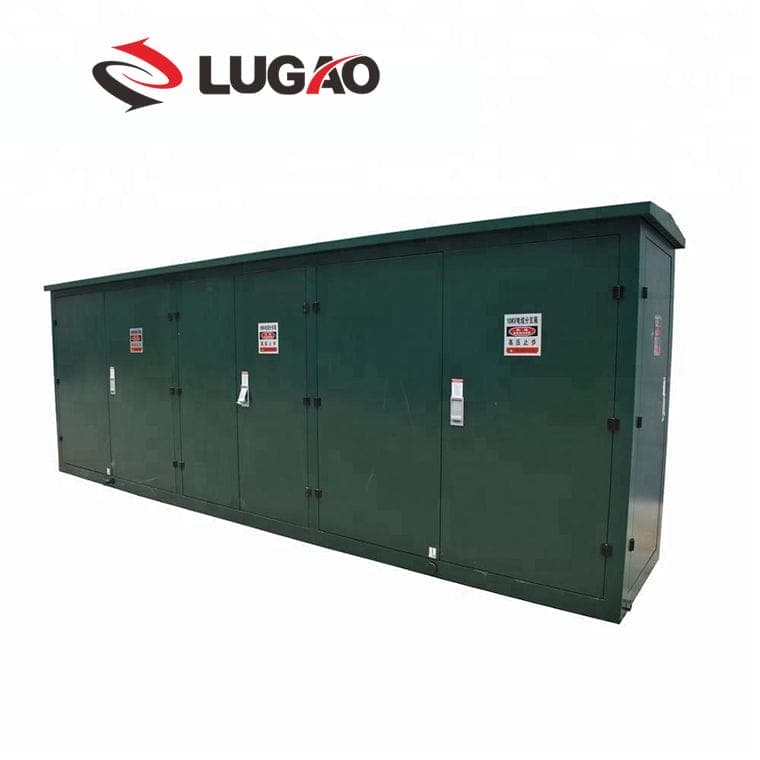
What Defines a Gas-Insulated Ring Main Unit Technically?
A Gas-Insulated Ring Main Unit (RMU) encapsulates all live components—circuit breakers, disconnectors, and earthing switches—inside a hermetically sealed stainless steel tank filled with an insulating gas. Most commonly, SF6 gas is used due to its exceptional dielectric strength, which is roughly three times that of air at the same pressure. Our factory at Lugao Power Co.,Ltd. produces Gas-Insulated RMUs from 12kV to 40.5kV, with rated currents up to 1250A. The sealed construction eliminates external environmental influences such as dust, humidity, salt fog, and small animals, making these units ideal for harsh environments like coastal wind farms or high-pollution industrial zones.
Key technical characteristics of our gas-insulated Ring Main Unit design include:
- Dielectric medium: SF6 or eco-friendly gas mixture (N2/SF6 blend) at 0.12–0.14 MPa relative pressure.
- Compact footprint: Width per panel typically 300mm to 400mm, reducing switchgear room size by up to 60% vs air-insulated.
- Sealed-for-life construction: Maintenance-free operation for 20+ years; no internal cleaning required.
- High short-circuit withstand: Up to 25kA/3s standard; our heavy-duty version reaches 31.5kA.
- Operational safety: All live parts enclosed – zero accidental contact risk.
- Internal arc classification: IAC AFLR 20kA/1s, ensuring personnel protection.
From our experience, gas-insulated RMUs excel in underground substations, commercial high-rises, and offshore platforms where space is premium. Our factory uses robotic laser welding for gas-tight seams and helium leak testing to guarantee less than 0.1% annual gas leakage. Additionally, modern gas-insulated Ring Main Unit designs include pressure gauges and low-density alarms to alert operators before any dielectric compromise. The thermal dissipation is managed via natural convection and external surface cooling, which is sufficient for most loading cycles. When you need a compact, high-reliability solution with minimal site work, our gas-insulated RMUs deliver unmatched performance.
How Do Air-Insulated Ring Main Units Operate and Perform?
Air-Insulated Ring Main Units use ambient atmospheric air as the primary insulating and arc-quenching medium. All busbars, switches, and fuses are housed within a metal-enclosed compartment but with open air gaps between phases and to ground. The typical design employs a three-position switch (closed, open, earthed) combined with vacuum circuit breaker technology for fault interruption. At Lugao Power Co.,Ltd., our Air-Insulated RMU panels range from 350mm to 600mm width per panel, rated up to 630A continuous current and 20kA short-circuit for 3 seconds. Because air is free and universally available, these units offer straightforward visual inspection of contacts and simple field modifications.
Operational characteristics of our air-insulated Ring Main Unit lines include:
- Open-ventilated design: Heat dissipation is excellent; no derating in normal ambient temperatures up to 40°C.
- Visible breaking gap: Operators can physically see the separation of contacts through observation windows.
- Lower initial capital cost: Approximately 30-40% less than gas-insulated equivalents for the same rating.
- No gas handling equipment needed: Simple tools for installation and maintenance.
- Flexibility for field modification: Adding cable boxes or auxiliary contacts is straightforward.
- Environmentally benign: Zero greenhouse gas emissions; no end-of-life disposal concerns.
Our factory produces air-insulated Ring Main Unit configurations that are type-tested according to IEC 62271-200. The enclosures are coated with anti-corrosion paint suitable for indoor or sheltered outdoor installation. However, users must ensure adequate clearance around the panel – typically 800mm front and rear for maintenance access. In dusty or humid locations, our air-insulated RMUs require periodic cleaning of insulators and bushings to prevent tracking currents. Despite this, many industrial clients prefer AIS for its simplicity, especially in temperate climates where space is not severely constrained. For transformer primary protection, air-insulated RMUs with SF6 or vacuum circuit breakers offer a cost-optimized balance. We regularly deliver both types, and our technical advisors help match the RMU to your specific site conditions.
What Are the Key Parameter Differences Between Gas and Air Insulated RMUs?
When comparing Gas-Insulated versus Air-Insulated Ring Main Units, engineers must evaluate a dozen critical parameters to ensure network stability and cost efficiency. Below is our factory’s technical comparison table based on standard 12kV, 630A RMU models. Both types are manufactured by Lugao Power Co.,Ltd. to IEC and GB standards. The data reflects real test results from our high-power laboratory.
| Parameter | Gas-Insulated Ring Main Unit | Air-Insulated Ring Main Unit |
| Insulation Medium | SF6 gas (or eco-friendly blend) at 0.12 MPa | Ambient air at atmospheric pressure |
| Dielectric Strength (relative) | 3x higher than air – reduces clearances | Baseline – requires larger phase spacing |
| Width per panel (mm) | 325 – 375 mm | 450 – 600 mm |
| Height x Depth (mm) | 1400 x 750 | 1600 x 900 |
| Rated current (max) | 1250A (natural cooling) / 2500A forced | 630A – 1250A (derated above 40°C) |
| Short-time withstand current | 25kA/3s (optional 31.5kA) | 20kA/3s |
| Internal arc classification | AFLR 20kA/1s | AFL 12.5kA/1s typical |
| Protection class (IEC) | IP67 (gas tank) / overall IP4X | IP3X – IP4X (ventilated) |
| Ambient temperature range | -40°C to +55°C | -25°C to +40°C (with derating) |
| Maintenance interval | 20+ years (sealed mechanism) | 3-5 years (cleaning & inspection) |
| Relative cost (per panel) | Higher (1.4x – 1.7x of AIS) | Baseline |
Beyond these quantifiable parameters, our engineering team notes that gas-insulated RMUs have virtually no altitude derating up to 3000m, whereas air-insulated units require correction factors above 1000m. For offshore or desert applications, the sealed gas tank prevents salt intrusion and sand accumulation. On the other hand, air-insulated Ring Main Unit designs allow easier visual identification of switch position – a significant operational advantage for utilities with less skilled personnel. Neither technology is universally superior; the best choice depends on lifecycle priorities. By leveraging our factory’s dual production lines, we customize solutions to meet your exact specifications, including mixed configurations with gas-insulated busbar and air-insulated feeders where needed.
Why Would You Choose Gas-Insulated Over Air-Insulated for Your Project?
Selecting a gas-insulated Ring Main Unit brings strategic advantages in four core scenarios: extreme space limitation, harsh environmental conditions, high continuity of service requirements, and long-term low maintenance. Lugao Power Co.,Ltd. has supplied over 15,000 gas-insulated RMU panels globally, and our clients consistently cite the following benefits. When space inside a building costs thousands per square meter, the compact nature of gas-insulated RMUs enables doubling distribution capacity within existing footprints. Our factory produces 24kV gas RMUs that occupy only 0.24 square meters per feeder, compared to 0.65 square meters for AIS.
Additional decisive factors for gas-insulated RMU adoption include:
- Immunity to pollution: No creepage distance compromise even in cement plants or coastal zones.
- Reduced fire risk: Internal faults are contained within the sealed tank; no ionized air propagation.
- High altitude performance: No derating up to 3500m – essential for mining or mountain substations.
- Low noise operation: No cooling fans or large moving contacts; magnetic switching is silent.
- Future-proof for IoT: Integrated sensors for temperature, gas pressure, and partial discharge available.
Conversely, you might choose air-insulated over gas when upfront budget is tight, or when local regulations restrict SF6 usage without recovery equipment. Our air-insulated Ring Main Unit range remains popular for rural electrification projects and small industrial plants where maintenance crews are stationed onsite. Moreover, for customers committed to full environmental transparency, our factory now offers eco-efficient Gas-Insulated RMUs using a g3 gas mixture (Green Gas for Grid) with 99% lower global warming potential. So even if environmental concerns arise, modern gas-insulated solutions from Lugao Power Co.,Ltd. can comply with stringent F-gas regulations. We always recommend a life cycle cost analysis – our technical team provides free modeling to show how gas RMUs often break even within 8 to 10 years due to reduced outage and maintenance costs.
How Do Maintenance Costs and Lifespan Compare Between Both RMU Types?
Maintenance philosophy differs fundamentally between gas-insulated and air-insulated Ring Main Units. A gas-insulated RMU follows a “sealed for life” strategy: the switchgear is filled with dielectric gas and sealed at the factory. For standard service conditions, our factory ensures that no internal maintenance is required for 20 years. The only periodic checks involve gas pressure indication and mechanical operation counter (every 2-3 years). When pressure falls below setpoint (extremely rare with our laser welds), gas refilling kits are supplied. In contrast, an air-insulated RMU demands regular cleaning of insulator surfaces (every 2-5 years depending on dust), lubrication of moving parts, and torque checks on busbar connections. Over a 20-year lifespan, cumulative maintenance cost for AIS can be 2 to 3 times higher than GIS initial plus operational cost.
Detailed comparative maintenance profile from our service records:
-
Gas-insulated RMU (Lugao Power GIS series):
- Year 1-20: only visual inspection of enclosure and gas pressure gauge annually.
- No spare parts for internal components – designed for minimal wear.
- Mean time to repair (MTTR) for gas module: 4 hours (replacement exchange).
- End-of-life: gas recovery and recycling available via our take-back program.
-
Air-insulated Ring Main Unit (Lugao Power AIS series):
- Annual: visual check for corrosion, dust, and mechanical alignment.
- Every 3 years: cleaning of post insulators with dry cloth or vacuum.
- Every 5 years: lubrication of switch operating mechanism (grease renewal).
- Every 10 years: contact erosion measurement; possible replacement of arcing contacts.
- Typical annual maintenance cost per panel: $80 – $120 (subject to site conditions).
Our factory recommends gas-insulated RMUs for remote or unattended substations where a service call would be costly and slow. For industrial plants with dedicated electrical staff, the air-insulated Ring Main Unit offers transparency and hands-on control. Lifespan for both types exceeds 30 years when properly maintained. We have GIS units from 1997 still in operation with zero interruption. Ultimately, total cost of ownership modeling should include not just maintenance but also outage costs – gas RMUs reduce unplanned outages due to environmental ingress. At Lugao, we provide 10-year warranty options on all gas-insulated RMU tanks, reflecting our confidence in leak-free construction. Contact our service engineers for a personalized TCO report comparing the two technologies on your actual network data.
Conclusion & CTA: Selecting the Right Ring Main Unit for Your Network
After dissecting the technical, operational, and financial aspects, the difference between gas-insulated and air-insulated Ring Main Units boils down to priorities: choose gas-insulated for compactness, harsh environments, and minimal maintenance; choose air-insulated for lowest upfront cost, simplicity, and visual confirmation of isolation. Both solutions have proven track records, and Lugao Power Co.,Ltd. delivers each with rigorous quality assurance. Our factory’s modular design platform allows us to produce both types on the same production line, ensuring consistent workmanship. Remember that a Ring Main Unit is a long-term investment – the initial selection influences your network’s reliability for decades.
Ready to evaluate which RMU fits your substation upgrade or new project? Lugao Power Co.,Ltd. offers free technical consultation, sample testing, and 3D layout designs for both gas-insulated and air-insulated configurations. Our sales engineers will provide customized quotations, including site commissioning and training.
Frequently Asked Questions (FAQ) – Gas-Insulated vs Air-Insulated Ring Main Units
Below questions are structured to align with Google AI Overview best practices for featured snippets. Each Q&A provides concise yet detailed, logically organized answers.
Question 1: What are the safety differences between Gas-Insulated and Air-Insulated Ring Main Units?
Answer: Gas-insulated Ring Main Units provide higher personnel safety because all live parts are fully enclosed in a grounded metallic tank. There is no exposed conductor, eliminating accidental contact risks even during maintenance. The sealed tank also contains any internal arc fault, directing energy out of pressure relief vents. Air-insulated RMUs have visible disconnects but require maintaining physical clearance distances to live parts. For high-fault current applications, gas-insulated design is inherently safer. Lugao designs both types to IEC 62271-200 internal arc requirements, but GIS offers superior containment.
Question 2: Can I replace an existing Air-Insulated RMU with a Gas-Insulated RMU without civil works?
Answer: Yes, often with significant advantages. Gas-insulated Ring Main Units have a 40-60% smaller footprint. Our factory’s retrofitting kits include adapter plates and cable connection chambers that align to existing cable pits. However, you must check floor loading – GIS tanks add around 30% more weight concentrated in smaller area. Usually the concrete floor suffices. Ventilation requirements reduce because GIS generates less heat from lower internal resistance. Lugao Power Co.,Ltd. provides 3D laser scanning services to map your substation and produce drop-in replacement GIS RMUs with minimal outage time.
Question 3: How does extreme cold weather impact Gas-Insulated vs Air-Insulated RMU operation?
Answer: Gas-insulated RMUs excel in arctic climates down to -40°C. The SF6 gas does not condense until -50°C; our factory adds low-temperature heaters on pressure gauges for reliable operation. There are no humidity condensation issues because the gas is dry inside the sealed tank. Air-insulated Ring Main Units face problems below -25°C: mechanisms stiffen, and ice bridging across insulators can cause flashovers. Anti-condensation heaters are mandatory. For projects in Siberia or Northern Canada, we strongly recommend our gas-insulated RMUs with cold climate package.
Question 4: What environmental regulations affect my choice between Gas and Air Insulated RMUs?
Answer: Air-insulated RMUs have no greenhouse gas concerns. Conventional SF6 gas-insulated RMUs are subject to F-gas regulations (EU 517/2014, US EPA) requiring leak detection and reporting. However, Lugao Power Co.,Ltd. now offers green gas-insulated Ring Main Units using Fluoronitrile mixtures with GWP <1. These units meet Kyoto protocol targets while retaining compact dimensions. For new projects we recommend our ecoGIS series. Check local regulations: some utilities ban SF6 but accept eco-efficient gases. Our factory provides full compliance documentation.
Question 5: How do I decide based on required short-circuit current rating (Icw)?
Answer: For systems requiring more than 20kA symmetrical short-circuit withstand (Icw) for 3 seconds, gas-insulated RMUs are the standard choice. Our gas-insulated Ring Main Unit models achieve 25kA or 31.5kA easily due to superior arc quenching. Air-insulated RMU designs typically max out at 20kA because air has lower arc mobility and larger contact gaps would be needed. If your fault level is 25kA and above, choose GIS. For 16kA or less, air-insulated will be cost-effective. Verify your network fault study before selection; Lugao Power Co.,Ltd. can run simulations free of charge.