
- English
- Español
- Português
- русский
- Français
- 日本語
- Deutsch
- tiếng Việt
- Italiano
- Nederlands
- ภาษาไทย
- Polski
- 한국어
- Svenska
- magyar
- Malay
- বাংলা ভাষার
- Dansk
- Suomi
- हिन्दी
- Pilipino
- Türkçe
- Gaeilge
- العربية
- Indonesia
- Norsk
- تمل
- český
- ελληνικά
- український
- Javanese
- فارسی
- தமிழ்
- తెలుగు
- नेपाली
- Burmese
- български
- ລາວ
- Latine
- Қазақша
- Euskal
- Azərbaycan
- Slovenský jazyk
- Македонски
- Lietuvos
- Eesti Keel
- Română
- Slovenski
- मराठी
- Srpski језик

What are the differences between indoor and outdoor high-voltage vacuum circuit breakers?
In modern power distribution systems, vacuum circuit breakers(VCBs) are crucial equipment for ensuring power supply safety and stability. Their main function is to quickly interrupt current and isolate lines during faults, preventing equipment damage and large-scale power outages. However, many purchasing and engineering personnel are often confused about the differences between indoor and outdoor VCBs when selecting models. Although both use vacuum arc-extinguishing technology, why are there such significant design differences? And how should one choose based on project scenarios?
As a professional power equipment manufacturer, Lugao Power, combining indoor and outdoor Vacuum Circuit Breaker products, breaks down the core differences, design features, and applicable scenarios of the two to help you easily choose the right equipment.
What is a Vacuum Circuit Breaker (VCB)?
Vacuum circuit breaker use a vacuum as both the arc-extinguishing medium and the insulating medium. They use a vacuum environment to extinguish the electric arc, thereby controlling and protecting the circuit. This avoids the use of oil or SF6 gas, making it safer and more environmentally friendly. They are widely used in power plants and substations, especially in applications requiring frequent operation.
The most basic way to distinguish them is by their installation environment. Vacuum circuit breakers are mainly divided into two categories: Indoor high-voltage vacuum circuit breakers: Suitable for use in enclosed and controlled indoor environments, compatible with standard switchgear, and meeting stable indoor operating conditions.
Outdoor high-voltage vacuum circuit breakers: Suitable for use in various uncertain outdoor environments, without worrying about adverse weather conditions.
Whether indoor or outdoor, high-voltage vacuum circuit breakers share the same core arc-extinguishing principle, but their structure, protection, and insulation designs are completely customized to suit different scenarios.
Indoor Vacuum Circuit Breakers (VS1 Series)
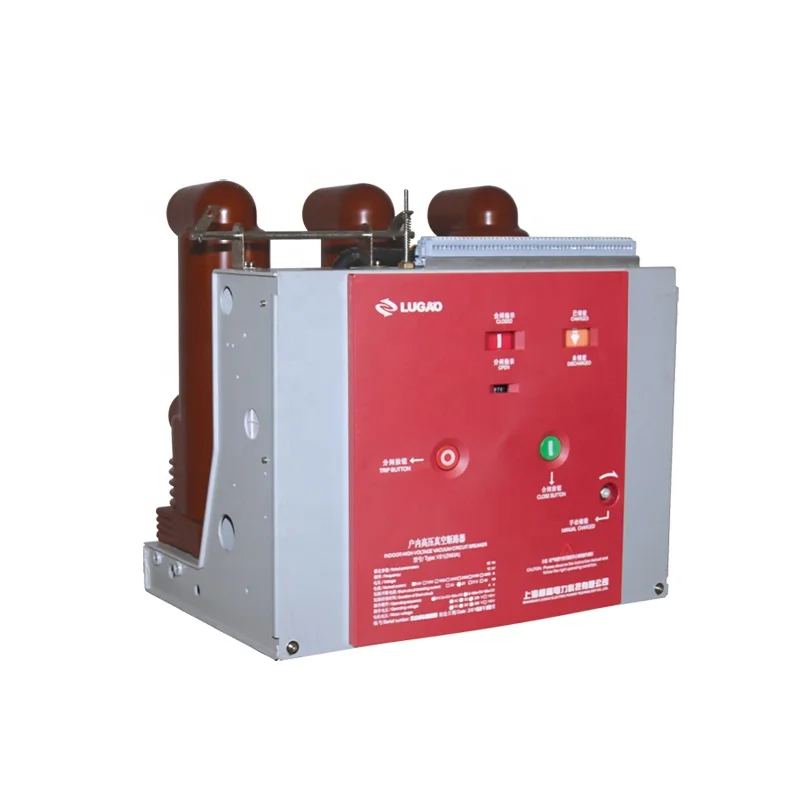
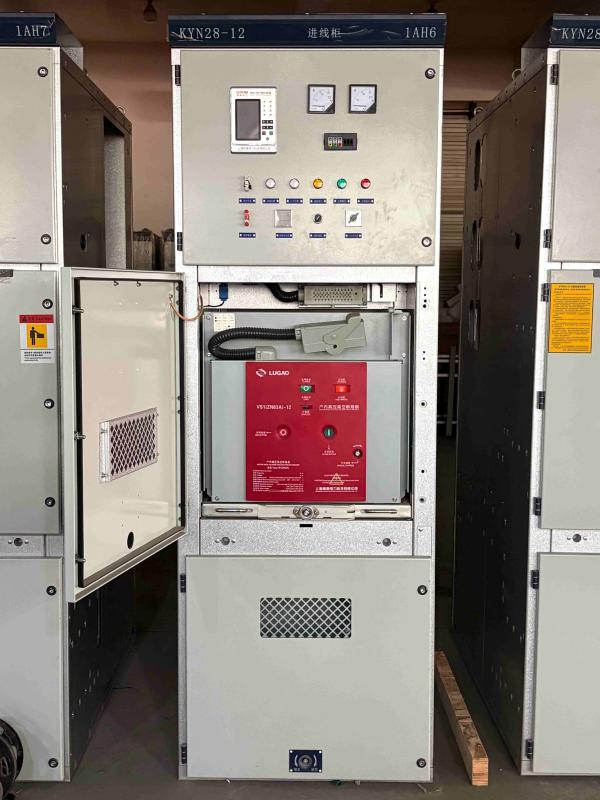
Indoor VCB is the most common type of circuit breaker, typically installed in enclosed spaces such as switchgear and indoor substations. Lugao Power's indoor vacuum circuit breakers are a typical example of cabinet-mounted designs. The operating mechanism is integrated into the circuit breaker body, allowing it to be used not only as a fixed installation unit but also with a dedicated propulsion mechanism to form a trolley unit. The main circuit section can utilize integrally sealed poles to achieve circuit breaker miniaturization and maintenance-free operation. It can be equipped with switchgear such as KYN28A-12, and fixed-type units can also be equipped with XGN series fixed-type switchgear.
Design Features
1. Compact Modular Structure, Adaptable to Standard Switchgear
The dimensions of the indoor VCB are strictly designed according to the dimensions of standard switchgear such as KYN28. It adopts a modular frame structure, allowing direct embedding into the cabinet for installation, maximizing the use of indoor power distribution space. Lugao's indoor Vacuum Circuit Breaker integrates a vacuum interrupter, operating mechanism, and control unit. The front panel is equipped with opening and closing buttons and status indicator lights for convenient operation and monitoring by operators.
2. Basic Protection Rating, Suitable for Clean Indoor Environments
Because it is installed in a dry, rain-free, and UV-free indoor environment, the protection rating of the indoor VCB is typically IP20~IP40, requiring only protection against accidental contact with fingers and tools and small amounts of dust, without needing to cope with harsh weather conditions.
3. Epoxy Resin Insulation Structure, Suitable for Cabinet Operating Conditions
The arc-extinguishing chamber of the indoor VCB is encapsulated with epoxy resin sleeves, providing phase-to-phase and phase-to-ground insulation, suitable for the dry and clean environment inside the switchgear. It is compact in size and provides reliable insulation.
4. Safety Isolation Achieved Through Switchgear
The indoor VCB itself does not have a visible disconnector switch; the safety isolation function is achieved by the grounding switch and disconnector switch of the switchgear, suitable for scenarios with comprehensive cabinet interlocking protection.
Outdoor Vacuum Circuit Breakers (ZW32 Series)
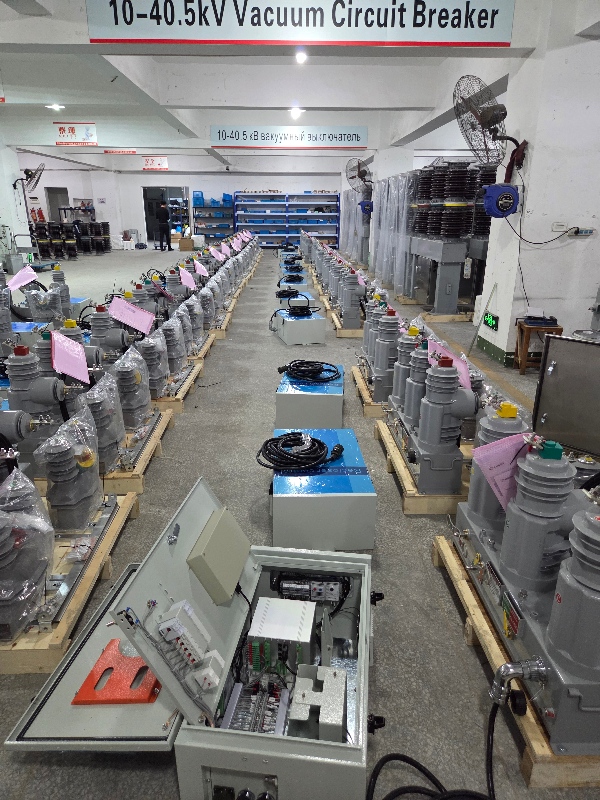
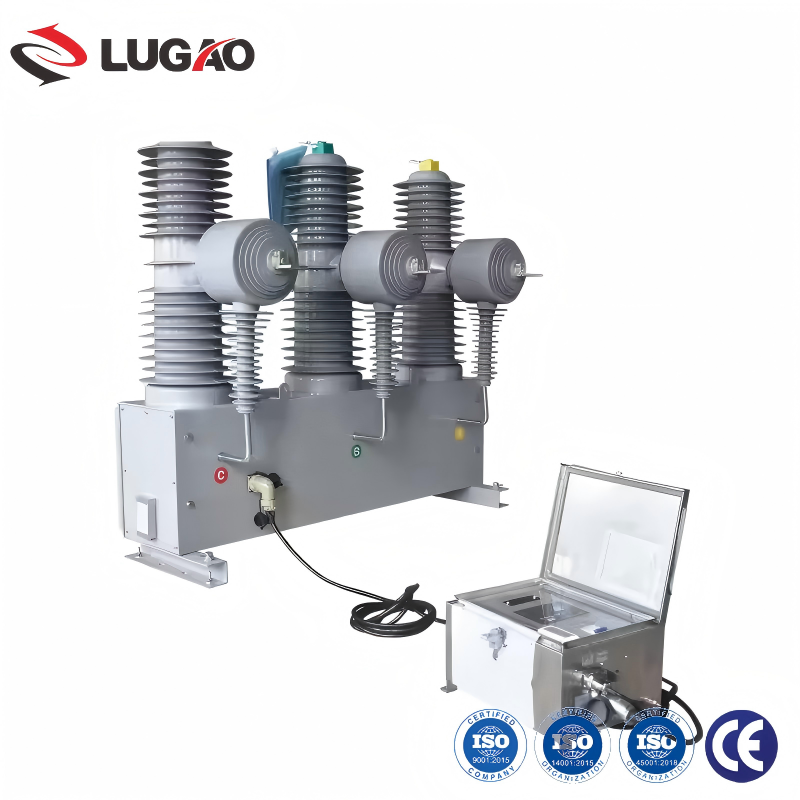
Because outdoor VCBs need to be exposed to the outdoors for extended periods, dealing with conditions such as sun and rain, extreme temperature differences, and dust pollution, their design emphasizes durability and protection. Lugao Electric's outdoor VCBs are characterized by their small size, light weight, anti-condensation properties, and maintenance-free operation:
Design Features
1. High-Sealing Three-Phase Post-Type Fully Enclosed Structure
Outdoor Vacuum Circuit Breakers adopt a fully sealed design, achieving a protection level of IP65 and above. They are completely waterproof, dustproof, and anti-condensation, allowing for stable operation in rain, snow, and dusty environments for extended periods. They are also resistant to high temperatures, UV radiation, and aging, unaffected by outdoor weather changes.
2. Large Creepage Distance Silicone Rubber Insulating Bushings
Outdoor Vacuum Circuit Breakers utilize large creepage distance silicone rubber (or ceramic) umbrella-skirt type insulating bushings. Compared to indoor epoxy resin bushings, this provides a longer creepage distance, preventing flashover discharge in humid and polluted outdoor environments and offering superior resistance to UV aging.
3. Convenient and flexible operation ensures safety. Lugao's outdoor Vacuum Circuit Breakers can be operated manually, electrically, or remotely. They provide clearly visible disconnections, ensuring reliable electrical isolation during maintenance without the need for additional disconnect switches, making them suitable for outdoor environments without enclosed switchgear.
4. Flexible installation options adaptable to outdoor scenarios. Outdoor VCBs support various installation methods, including pole-mounted and floor-mounted installations, eliminating the need for a dedicated indoor distribution room. This makes them particularly suitable for locations requiring frequent operation.
Comparison Table of Core Differences between Indoor and Outdoor Vacuum Circuit Breakers
|
Product |
Indoor Vacuum Circuit Breaker |
Outdoor Vacuum Circuit Breaker |
|
Applicable Environment |
Enclosed, dry indoor environments(switchgear, indoor substations) |
Exposed, harsh outdoor environments (overhead lines, pole-mounted installations) |
|
Protection Rating |
IP20~IP40 (protects against accidental contact and minor dust only) |
IP65 and above (fully waterproof, dustproof, and condensation-proof) |
|
Insulation Structure |
Epoxy resin bushing, short creepage distance |
Silicone rubber/ceramic umbrella skirt bushing, large creepage distance, pollution-resistant and flashover-proof |
|
Installation Method |
Embedded in standard switchgear |
Pole-mounted, floor-mounted outdoor installation |
|
Safety Isolation |
Relies on disconnect switches/grounding switches within the switchgear. |
Integrated disconnect switch, providing a visible break. |
|
Weather Resistance |
No UV resistance, waterproof design |
High and low temperature resistance, UV resistance, rain and snow protection, dust protection |
|
Maintenance Convenience |
Indoor cabinet maintenance, environmentally controllable. |
Outdoor maintenance-free design, suitable for various scenarios. |
|
Typical Voltage Rating |
Medium voltage 10kV~35kV |
Medium voltage 10kV~40.5kV |
How to choose the right Vacuum Circuit Breaker for your project?
When selecting a VCB, focus on three key aspects: installation environment, protection requirements, and maintenance scenarios:
1. Prioritize the installation environment. If the equipment is installed in an enclosed space such as an indoor switchgear or distribution room, an indoor VCB is sufficient, offering lower costs and better compatibility. However, for outdoor overhead lines or pole-mounted scenarios, an outdoor VCB must be selected; otherwise, the equipment will be quickly damaged by rain, condensation, and pollution.
2. Assess the severity of the environment. For heavily polluted and corrosive environments such as coastal areas and chemical industrial parks, even indoor environments should prioritize high-protection-level indoor VCBs. In heavily polluted outdoor areas, large creepage distance and anti-fouling outdoor VCBs should be selected.
3. Consider maintenance needs. For remote outdoor scenarios, prioritize outdoor VCBs with integrated disconnect switches and maintenance-free designs to reduce on-site maintenance difficulties. For indoor scenarios, select a suitable indoor VCB model based on the switchgear configuration.
As a factory with over 20 years of manufacturing experience, Lugao Power can provide customized VCB selection solutions based on your project's voltage level, current parameters, and installation environment, helping you match the most suitable equipment.
FAQ: Indoor vs. Outdoor Vacuum Circuit Breaker
1.Can I use an indoor VCB outdoors to save cost?
This is not recommended. Indoor vacuum circuit breakers lack the necessary features for outdoor use, such as rainproof, UV-resistant, and pollution-resistant insulation. This poses a safety hazard and will void the warranty.
2.Can the same VCB model work for both indoor and outdoor projects?
They are not interchangeable. Although they employ the same vacuum breaking technology, their mechanical and insulation designs are specifically tailored for particular environments. Using the wrong type can lead to premature damage and safety hazards.
3. Do outdoor VCBs require maintenance?
Lugao's outdoor vacuum circuit breakers are designed with a fully enclosed structure, allowing for low-maintenance or maintenance-free operation. However, regular visual inspection of the insulator condition is still recommended.
4.Are the selection logics for indoor and outdoor VCBs the same for 10kV and 35kV?
The logic is exactly the same,first, determine the installation environment,the selection principle remains unchanged regardless of the voltage level.
5.Is there a big price difference between the two types of VCBs?
For the same voltage and current specifications, outdoor VCBs are more expensive than indoor ones. This is because the outdoor model uses high weather-resistant insulation, a fully sealed waterproof structure, and a thicker shell, resulting in higher manufacturing and material costs.
Ready to Find the Right VCB for Your Project?
View details of Lugao Power's indoor vacuum circuit breaker series
View details of Lugao Power's outdoor vacuum circuit breaker series
Contact Lugao's technical team for a free project-specific selection solution and quotation!