
- English
- Español
- Português
- русский
- Français
- 日本語
- Deutsch
- tiếng Việt
- Italiano
- Nederlands
- ภาษาไทย
- Polski
- 한국어
- Svenska
- magyar
- Malay
- বাংলা ভাষার
- Dansk
- Suomi
- हिन्दी
- Pilipino
- Türkçe
- Gaeilge
- العربية
- Indonesia
- Norsk
- تمل
- český
- ελληνικά
- український
- Javanese
- فارسی
- தமிழ்
- తెలుగు
- नेपाली
- Burmese
- български
- ລາວ
- Latine
- Қазақша
- Euskal
- Azərbaycan
- Slovenský jazyk
- Македонски
- Lietuvos
- Eesti Keel
- Română
- Slovenski
- मराठी
- Srpski језик

Why Does SF6 Gas Density Monitoring Matter for High-Voltage Circuit Breaker Reliability?
An Outdoor SF6 Circuit Breaker can sit in a substation for months without operation, then be called upon to interrupt a fault current of tens of kiloamperes in a few tens of milliseconds. The insulation and the arc-quenching capability that make this possible depend on one physical property: the density of the SF6 gas inside the interrupter. Pressure alone does not tell the whole story, because pressure changes with temperature even when the mass of gas is constant. Density, which is the mass of gas per unit volume, remains constant as long as no gas escapes. This is why density monitoring, not simple pressure gauging, is the measurement that connects the gas condition to the breaker's protective capability. A breaker that loses gas slowly can still show a normal pressure on a cold morning and an alarm condition on a hot afternoon, or the reverse. Density monitoring removes that ambiguity.
For a procurement team sourcing Outdoor SF6 Circuit Breakers, the density monitoring system is not an accessory. It is the condition-monitoring layer that determines whether the breaker can be relied upon to interrupt a fault, and whether maintenance can be planned before a gas loss becomes a failure. This article explains what SF6 density represents, why density monitoring is a reliability function rather than a maintenance convenience, how a density monitor detects a leak before it becomes a failure, which specifications buyers should check, and how procurement can verify the monitoring performance before an order is placed. Our factory at Lugao Power Co.,Ltd. integrates density monitoring into the Outdoor SF6 Circuit Breakers we supply, and the guidance below reflects the engineering and procurement questions we address with our customers.
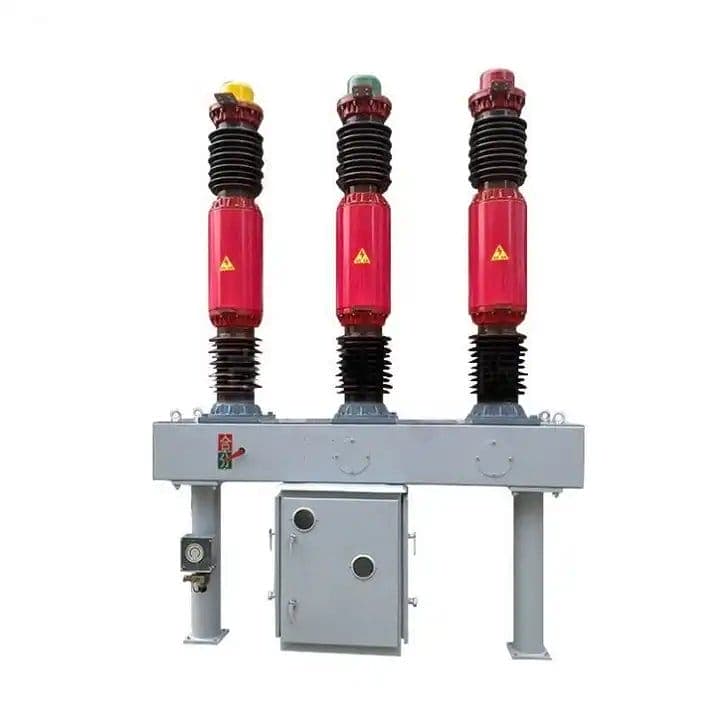
Table of Contents
- 1. What Does SF6 Gas Density Actually Represent in a Circuit Breaker?
- 2. Why Is Density Monitoring a Reliability Function, Not a Maintenance Convenience?
- 3. How Does a Density Monitor Detect a Leak Before It Becomes a Failure?
- 4. What Specifications Should Buyers Check on a Density Monitor?
- 5. How Should Procurement Verify Density Monitoring Performance?
- 6. Frequently Asked Questions (FAQ)
- 7. Conclusion
1. What Does SF6 Gas Density Actually Represent in a Circuit Breaker?
SF6 gas density is the mass of sulfur hexafluoride per unit volume inside the sealed interrupter. It is the property that determines the dielectric strength of the gas and its ability to quench an arc. When the breaker is filled at the factory, the gas is introduced to a specified density at a reference temperature, typically 20°C. That density corresponds to a defined pressure at that temperature, and the relationship between pressure, temperature, and density is described by the gas laws and the compressibility factor of SF6. If the gas leaks, the density falls. If the temperature rises, the pressure rises but the density does not change, provided the enclosure is sealed.
This is the key distinction that buyers must understand. A pressure gauge reads the pressure inside the enclosure. On a cold morning, the pressure may read below the alarm threshold even though the gas density is correct. On a hot afternoon, the pressure may read above the alarm threshold even though the gas density has fallen due to a leak. A density monitor compensates for temperature and reports the density, or the pressure corrected to a reference temperature, so that the reading reflects the actual mass of gas in the enclosure. The table below compares the two measurement approaches.
| Measurement | What It Reports | Effect of Temperature | Reliability Implication |
| Pressure gauge | Absolute or gauge pressure | Pressure changes with temperature even at constant density | Can trigger false alarms or mask a real leak |
| Density monitor | Density or temperature-compensated pressure | Compensates for temperature, reflects gas mass | Provides a true indication of insulation and arc-quenching capability |
| Temperature sensor | Gas or ambient temperature | Direct reading | Used by the density monitor for compensation |
The density value is directly linked to the breaker's performance. The dielectric strength of SF6 is roughly proportional to its density, and the arc-quenching capability depends on the gas density in the puffer chamber. A breaker that operates at a reduced density may still open a fault, but the margin of safety is reduced, and the risk of restrike or failure to interrupt increases. This is why the density thresholds, the alarm levels, and the lockout levels are set with reference to the breaker's rated performance, not with reference to a generic pressure value.
At our factory, we fill each Outdoor SF6 Circuit Breaker to a specified density and verify the density at the reference temperature before shipment. We also verify the density monitor's alarm and lockout settings against the breaker's rating. The goal is to ensure that the monitoring system reports the gas condition in the same terms that the breaker's performance is defined.
2. Why Is Density Monitoring a Reliability Function, Not a Maintenance Convenience?
Density monitoring is a reliability function because it is the only continuous indication of the breaker's ability to perform its protective role. A breaker that has lost gas density may still be in service, but its insulation margin and its arc-quenching capability are reduced. Without density monitoring, the loss may remain undetected until the breaker is called upon to interrupt a fault, and the failure may occur at the moment of greatest consequence. With density monitoring, the loss is detected as a trend, an alarm is raised at the first threshold, and maintenance can be scheduled before the lockout threshold is reached.
The scenario below illustrates the difference between a breaker with density monitoring and one without, using a slow leak that develops over several months.
- Month 1: A small leak begins at a seal. The gas density falls by a fraction of a percent. The density monitor records the value, and the trend is below the alarm threshold. No action is required, but the trend is visible in the monitoring record.
- Month 2: The density continues to fall. The monitor's first alarm threshold is approached. The control system logs the approach, and the maintenance team is alerted to plan an inspection.
- Month 3: The first alarm threshold is reached. The monitor closes its alarm contact, and the SCADA system generates a maintenance work order. The breaker remains in service, but the maintenance is scheduled before the next threshold.
- Month 4: The leak is repaired during a planned outage. The density is restored, and the monitor returns to its normal state. The breaker continues in service without an unplanned outage.
- Without monitoring: The leak continues undetected. The density falls below the lockout threshold. The breaker may be unable to interrupt a fault, or it may fail during a routine operation. The result is an unplanned outage and a potential safety event.
The reliability function is also visible in the way the density monitor interacts with the breaker's control and protection system. The monitor's alarm and lockout contacts are wired to the station control system, and they can block closing, initiate an alarm, or trip the breaker depending on the station philosophy. This integration makes the density monitor part of the protection chain, not just a gauge on the panel. The table below summarizes the functions of the density monitor in the reliability chain.
| Function | Description | Reliability Benefit |
| Continuous density reading | Temperature-compensated density value | Detects slow leaks before they become critical |
| First alarm contact | Signals a low-density condition | Allows planned maintenance |
| Lockout contact | Blocks operation when density is too low | Prevents operation outside the rated capability |
| Trend recording | Historical density data | Supports condition-based maintenance and leak diagnosis |
At Lugao Power Co.,Ltd., our factory integrates density monitoring into the Outdoor SF6 Circuit Breakers we supply, with alarm and lockout contacts wired to the station control interface. We also provide the density threshold settings and the reference temperature for each breaker. The goal is to make the density monitor a working part of the reliability chain, not a passive indicator.
3. How Does a Density Monitor Detect a Leak Before It Becomes a Failure?
A density monitor detects a leak by measuring the gas density continuously and comparing it to the alarm and lockout thresholds. The monitor is typically a temperature-compensated pressure switch or a combined sensor and switch unit. It contains a pressure sensing element, a temperature sensing element, and a mechanism that compensates the pressure reading to the reference temperature. The compensated value is compared to the set points, and the contacts change state when the thresholds are crossed. The leak detection is therefore a threshold function, but the trend between the thresholds is what allows the maintenance team to act before the failure.
The monitoring system has three layers: the local monitor, the signal interface, and the station control system. The local monitor is mounted on the breaker and provides the visual indication and the contact outputs. The signal interface carries the contacts to the station control system. The station control system logs the alarms and the trends. The table below describes the layers and their roles.
| Layer | Component | Role | Procurement Consideration |
| Local monitor | Density monitor with pressure and temperature sensing | Measures density, provides visual indication and contacts | Accuracy, set point range, contact rating |
| Signal interface | Wiring and terminal block | Carries alarm and lockout contacts to the control system | Wiring diagram, terminal identification |
| Station control | SCADA or protection relay | Logs alarms, trends, and initiates maintenance | Signal compatibility, alarm philosophy |
The detection of a leak before it becomes a failure depends on the threshold settings and the maintenance response. If the first alarm threshold is set too close to the lockout threshold, the maintenance team has little time to act. If the first alarm threshold is set too far from the lockout threshold, the alarm may be treated as a nuisance. The correct settings are derived from the breaker's rated density, the leakage rate specification, and the maintenance interval. Our factory at Lugao sets the density thresholds for each Outdoor SF6 Circuit Breaker with reference to the breaker's rating and the customer's maintenance philosophy, and we document the settings in the product manual.
For a buyer, the threshold settings are a specification that should be reviewed before the order is placed. The supplier should state the first alarm density, the lockout density, the reference temperature, and the leakage rate specification. A supplier that provides only a generic density monitor without the threshold settings is a supplier that is leaving the reliability function incomplete.
4. What Specifications Should Buyers Check on a Density Monitor?
The specifications that matter on a density monitor fall into four groups: the measurement accuracy, the set point range, the contact rating, and the environmental rating. The measurement accuracy determines whether the density reading can be trusted. The set point range determines whether the monitor can be configured for the breaker's thresholds. The contact rating determines whether the monitor can drive the station control interface. The environmental rating determines whether the monitor can survive the outdoor substation environment. The table below presents the specifications for a typical density monitor used on an Outdoor SF6 Circuit Breaker.
| Parameter | Typical Specification | Procurement Check |
| Density measurement accuracy | +/- 1% to +/- 2% of full scale | Confirm the accuracy supports the alarm margin |
| Reference temperature | 20°C | Confirm the reference matches the breaker rating |
| First alarm set point | Adjustable, typically 90% to 95% of rated density | Confirm the set point matches the maintenance philosophy |
| Lockout set point | Adjustable, typically 85% to 90% of rated density | Confirm the lockout protects the breaker rating |
| Contact rating | AC 250 V, 5 A or DC 220 V, 2 A | Confirm the contact can drive the control circuit |
| Environmental rating | IP65 or higher, -40°C to +80°C | Confirm the monitor suits the outdoor site |
| Leakage rate specification | < 0.1% per year | Confirm the breaker meets the leakage target |
The accuracy specification deserves special attention. If the monitor's accuracy is +/- 2% of full scale, and the margin between the rated density and the first alarm is only 5%, then the measurement uncertainty consumes a large part of the margin. The buyer should confirm that the accuracy is consistent with the alarm and lockout settings, and that the monitor is calibrated at the reference temperature. Our factory at Lugao Power Co.,Ltd. calibrates the density monitors for our Outdoor SF6 Circuit Breakers and provides the calibration certificate with the breaker. The goal is to ensure that the density reading is accurate enough to support the reliability function.
For a buyer, the density monitor specifications should be stated in the purchase order, not left to the supplier's default. The first alarm and lockout set points, the reference temperature, and the contact rating should be confirmed against the station design. A supplier that accepts these requirements and documents the settings is a supplier that is treating the density monitor as part of the breaker, not as an afterthought.
5. How Should Procurement Verify Density Monitoring Performance?
Procurement should verify density monitoring performance by requiring a calibration certificate, a set point record, a contact test report, and a leakage rate test report. The verification should be completed before the breaker is shipped, and the documents should be retained for the station's maintenance record. The checklist below provides the verification steps.
| Verification Step | What to Request | Acceptance Criterion |
| Calibration certificate | Monitor calibration at the reference temperature | Accuracy within the stated tolerance |
| Set point record | First alarm and lockout set points | Match the breaker rating and the maintenance philosophy |
| Contact test report | Alarm and lockout contact operation | Contacts change state at the set points |
| Leakage rate test report | Factory leak test of the breaker enclosure | Within the specified leakage rate |
| Threshold documentation | Density thresholds and reference temperature in the manual | Documented and traceable |
Our factory at Lugao Power Co.,Ltd. provides these documents with the Outdoor SF6 Circuit Breakers we supply. We also provide the density monitor model, the calibration date, and the set point values in the product documentation. The goal is to give buyers the evidence they need to confirm that the density monitoring system will perform its reliability function in the station.
For a buyer, the verification should also include a review of the supplier's leak testing process. A breaker that is filled and tested at the factory but leaks in service is a breaker that will trigger alarms and require maintenance. The supplier's leakage rate specification and the factory test method should be reviewed before the order is placed. A supplier that provides a leakage rate specification and a test report is a supplier that is controlling the gas condition, not just installing a monitor.
6. Frequently Asked Questions (FAQ)
Question 1: Why is density monitoring more reliable than pressure monitoring for an SF6 circuit breaker?
Answer: Pressure changes with temperature even when the mass of gas is constant, so a pressure reading can be misleading on a cold or hot day. Density monitoring compensates for temperature and reports the actual mass of gas per unit volume, which is the property that determines the dielectric strength and the arc-quenching capability. A density monitor therefore reflects the breaker's true condition, while a pressure gauge can produce false alarms or mask a real leak.
Question 2: What are the typical alarm and lockout thresholds for SF6 density monitoring?
Answer: The typical first alarm threshold is 90% to 95% of the rated density, and the lockout threshold is 85% to 90% of the rated density. The exact values depend on the breaker design and the maintenance philosophy. The first alarm allows planned maintenance before the lockout is reached, and the lockout prevents operation outside the rated capability. The thresholds should be set with reference to the breaker's rating and documented in the product manual.
Question 3: How does a density monitor detect a slow leak?
Answer: A density monitor measures the temperature-compensated density continuously and compares it to the alarm and lockout set points. A slow leak causes the density to fall gradually, and the monitor records the trend. When the first alarm threshold is reached, the monitor closes its alarm contact, and the station control system generates a maintenance alert. The trend data between the thresholds allows the maintenance team to schedule the repair before the lockout is reached.
Question 4: What accuracy should I require from a density monitor?
Answer: A typical density monitor has an accuracy of +/- 1% to +/- 2% of full scale. The required accuracy depends on the margin between the rated density and the first alarm threshold. If the margin is small, a higher accuracy is needed to avoid false alarms. The buyer should confirm that the accuracy is consistent with the alarm and lockout settings and that the monitor is calibrated at the reference temperature.
Question 5: What documentation should accompany a density monitor on an outdoor SF6 circuit breaker?
Answer: The documentation should include the calibration certificate, the set point record for the first alarm and lockout, the contact test report, the leakage rate test report, and the threshold documentation in the product manual. These documents allow the buyer to verify that the density monitoring system is calibrated, configured, and tested before the breaker is placed in service.
7. Conclusion
SF6 gas density monitoring matters for high-voltage circuit breaker reliability because density, not pressure, is the property that determines the breaker's insulation and arc-quenching capability. A density monitor compensates for temperature, detects slow leaks as a trend, and provides the alarm and lockout contacts that allow maintenance to be planned before a gas loss becomes a failure. For procurement teams, the density monitor is a reliability function, not an accessory, and the specifications, set points, and documentation should be verified before the breaker is ordered. Our factory at Lugao Power Co.,Ltd. integrates density monitoring into the Outdoor SF6 Circuit Breakers we supply and provides the calibration, set point, and leak test documentation that buyers need. If you are sourcing an Outdoor SF6 Circuit Breaker and need to confirm the density monitoring performance, contact our team to discuss the set points and the documentation for your station.
Contact Lugao Power Co.,Ltd. today to discuss your Outdoor SF6 Circuit Breaker requirements and to request the density monitoring specifications and documentation for your application.