
- English
- Español
- Português
- русский
- Français
- 日本語
- Deutsch
- tiếng Việt
- Italiano
- Nederlands
- ภาษาไทย
- Polski
- 한국어
- Svenska
- magyar
- Malay
- বাংলা ভাষার
- Dansk
- Suomi
- हिन्दी
- Pilipino
- Türkçe
- Gaeilge
- العربية
- Indonesia
- Norsk
- تمل
- český
- ελληνικά
- український
- Javanese
- فارسی
- தமிழ்
- తెలుగు
- नेपाली
- Burmese
- български
- ລາວ
- Latine
- Қазақша
- Euskal
- Azərbaycan
- Slovenský jazyk
- Македонски
- Lietuvos
- Eesti Keel
- Română
- Slovenski
- मराठी
- Srpski језик

How Do High Voltage Circuit Breakers Handle Short Circuits and Overloads?
In high voltage power systems, short circuits and overloads are inevitable occurrences that can cause catastrophic damage to equipment, disrupt power supply, and endanger personnel. The High Voltage Circuit Breaker is the primary protection device that must detect, interrupt, and isolate these fault conditions within milliseconds. But how exactly does a High Voltage Circuit Breaker handle such extreme electrical events? The process involves a sophisticated sequence of detection, relay coordination, mechanical operation, and arc extinction. When a short circuit or overload occurs, the current can rise to values 10 to 50 times the normal operating current, generating immense thermal and mechanical stress. The High Voltage Circuit Breaker must not only open its contacts to break the circuit but also extinguish the resulting electric arc quickly and safely, preventing re-ignition. At Lugao Power Co.,Ltd., our factory has been manufacturing High Voltage Circuit Breakers for over 20 years, and we have refined the interruption mechanisms to handle fault currents up to 80 kA at voltages up to 550 kV.
The handling of short circuits and overloads differs in both detection and interruption strategy. An overload is a moderate but sustained overcurrent, typically 1.2 to 2 times the rated current, which can cause thermal damage if allowed to persist. Short circuits are more severe, with currents that can exceed 10 times the rated value, creating massive magnetic forces and arc energies. The High Voltage Circuit Breaker uses protective relays to distinguish between these events and initiate the appropriate response. For overloads, the breaker may employ a time-delayed trip to allow temporary overloads to clear. For short circuits, the breaker must operate instantaneously, often within 2 to 3 cycles (30 to 50 milliseconds). This article explores the detailed mechanisms—from fault detection to arc quenching—that enable the High Voltage Circuit Breaker to handle these extreme conditions reliably. We also share technical specifications from our factory's product line and practical maintenance insights.
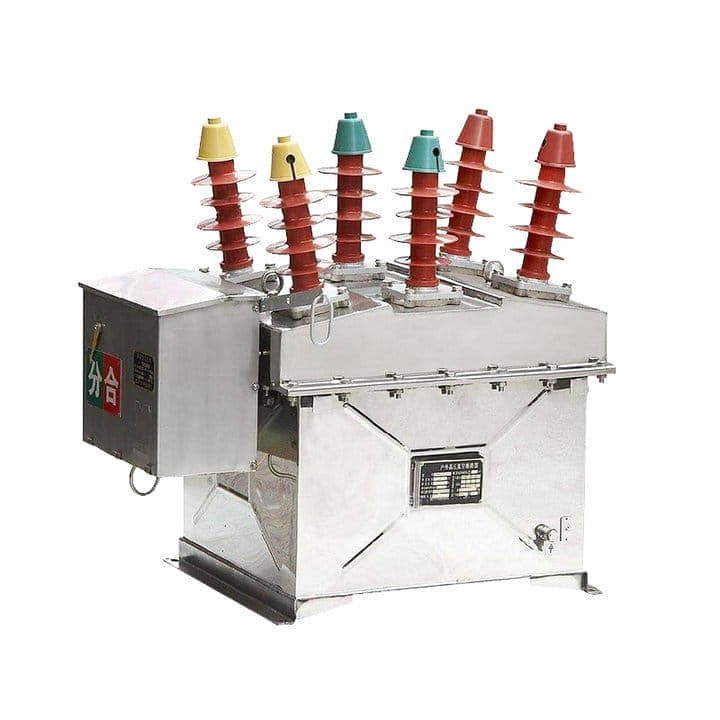
Table of Contents
- 1. What Happens Inside a High Voltage Circuit Breaker During a Short Circuit?
- 2. How Does the High Voltage Circuit Breaker Detect and Differentiate Between Overloads and Short Circuits?
- 3. What Are the Key Technical Specifications for Fault Interruption?
- 4. How Can Maintenance and Testing Ensure Reliable Fault Handling?
- Frequently Asked Questions (FAQ)
- Conclusion and Protection System Consultation
What Happens Inside a High Voltage Circuit Breaker During a Short Circuit?
When a short circuit occurs, the current in the power system surges instantly, and the High Voltage Circuit Breaker must respond with extreme speed. The sequence of events inside the breaker is a finely choreographed mechanical and electrical process. Upon receiving a trip signal from the protection relay, the operating mechanism (spring, hydraulic, or pneumatic) releases stored energy, causing the moving contact to separate from the fixed contact. At the moment of separation, an electric arc forms across the contact gap, sustained by the high fault current. This arc generates temperatures of 15,000 to 20,000 Kelvin, which would vaporize the contacts and destroy the breaker if not controlled. Therefore, the High Voltage Circuit Breaker relies on an arc quenching medium—either SF6 gas, vacuum, or oil—to cool and deionize the arc, extinguishing it at the next current zero crossing. The entire process from fault inception to current interruption must occur within 3 to 5 power cycles (50 to 80 milliseconds).
Detailed step-by-step process inside the High Voltage Circuit Breaker during a short circuit:
- Step 1: Fault detection and relay initiation: Current transformers (CTs) sense the abrupt current increase and send a signal to the protection relay. The relay compares the current against the pickup setting and determines if the fault is a short circuit or an overload. For a short circuit, the relay sends an instantaneous trip command to the breaker.
- Step 2: Operating mechanism activation: The trip coil is energized, releasing the latch that holds the operating mechanism. In a spring-operated breaker, the spring releases and drives the moving contact via a linkage system. In a hydraulic breaker, high-pressure oil is directed to a piston that moves the contact. This mechanical action typically takes 5 to 15 milliseconds.
- Step 3: Contact separation and arcing: As the moving contact pulls away, an arc bridges the gap. The arc is initially driven by the high current and the magnetic forces generated. The arcing contacts, made of materials like copper-tungsten or silver-tungsten, resist melting but still experience significant erosion.
- Step 4: Arc quenching: In an SF6 High Voltage Circuit Breaker, a puffer mechanism compresses the SF6 gas and directs it through a nozzle across the arc. The high-velocity gas flow removes heat and ionized particles, while the electronegative SF6 molecules capture free electrons, preventing re-ionization. In a vacuum breaker, the arc is extinguished by the rapid diffusion of metallic vapor in the vacuum environment.
- Step 5: Current zero interruption: The arc is extinguished at the next current zero (when the AC waveform crosses zero). After interruption, the dielectric strength across the open contacts must recover quickly to withstand the transient recovery voltage (TRV) that appears across the gap. The breaker must remain open, preventing a restrike.
To illustrate the severity of a short circuit event, consider a 145 kV system with a fault current of 40 kA. The energy released in the arc can exceed 100 MJ, enough to melt 50 kg of copper. Our High Voltage Circuit Breaker at Lugao is designed to handle such events with minimal contact erosion. The SF6 puffer mechanism we employ has been optimized through computational fluid dynamics (CFD) to ensure that the gas flow velocity exceeds Mach 2 at the nozzle throat, ensuring rapid arc extinction. In type tests, our High Voltage Circuit Breaker has successfully interrupted 40 kA faults at 145 kV for 20 consecutive operations without any degradation in performance. This robust design gives utilities confidence that their system will be protected even under the most severe short circuit conditions.
How Does the High Voltage Circuit Breaker Detect and Differentiate Between Overloads and Short Circuits?
The ability to distinguish between overloads and short circuits is crucial for the reliable operation of a power system. An overload is a condition where the current exceeds the rated value but is not an immediate threat to equipment, and it may be temporary (e.g., starting a large motor). A short circuit is a serious fault that requires instantaneous clearing. The High Voltage Circuit Breaker relies on protection relays—either electromechanical, solid-state, or microprocessor-based—to make this distinction. These relays receive current inputs from current transformers (CTs) and voltage inputs from potential transformers (PTs), and they use specific algorithms and time-current characteristics to differentiate between the two conditions. The relay then sends a trip signal to the High Voltage Circuit Breaker with the appropriate timing.
How the High Voltage Circuit Breaker detection system differentiates faults:
- Inverse-time overcurrent protection (for overloads): The relay uses an inverse-time characteristic curve, where the trip time decreases as the current increases. For a moderate overload (e.g., 120 percent of rated current), the trip time may be several seconds, allowing temporary overloads to pass. If the overload persists, the relay trips the High Voltage Circuit Breaker to prevent thermal damage.
- Instantaneous overcurrent protection (for short circuits): For currents exceeding a high pickup threshold (typically 8 to 12 times the rated current), the relay operates instantaneously, sending a trip signal without intentional delay. This ensures that the High Voltage Circuit Breaker opens within 20 to 30 milliseconds, limiting the damage to equipment.
- Directional overcurrent protection: In networked systems, faults may occur in either direction. Directional relays use both current and voltage inputs to determine the direction of the fault, ensuring that only the High Voltage Circuit Breaker closest to the fault opens, while others remain closed to maintain power flow.
- Ground fault protection: For single-line-to-ground faults, which are common in high voltage systems, residual current detection is used. The relay monitors the zero-sequence current, which is the sum of the three-phase currents. If the zero-sequence current exceeds a set threshold, the relay trips the High Voltage Circuit Breaker.
Modern High Voltage Circuit Breaker systems use numerical relays with communication capabilities, enabling remote monitoring and coordination with other breakers in the substation. These relays can also store event records and fault waveforms, which are invaluable for post-fault analysis. Our factory at Lugao Power Co.,Ltd. provides a comprehensive protection relay coordination service, ensuring that the settings for our High Voltage Circuit Breaker are optimally matched to your system's requirements. We use industry-standard coordination software to simulate different fault scenarios and verify that the relay settings provide selective coordination, meaning that only the breaker closest to the fault operates.
A practical example: In a 230 kV transmission line, the protection relay for a High Voltage Circuit Breaker may be set to trip at 1.2 times the rated current for an overload with a time dial setting of 2 seconds, and at 12 times the rated current for instantaneous trip. If a large motor starts, causing a 1.4 times current surge, the relay will not trip because the overload duration is short. However, if a phase-to-phase fault occurs, the current may reach 18 times the rated value, and the relay will trip the High Voltage Circuit Breaker instantaneously, clearing the fault within 3 cycles. This selective coordination is essential for maintaining system stability and preventing cascading outages. Lugao Power Co.,Ltd. provides a detailed relay setting guide with every High Voltage Circuit Breaker, assisting utilities in achieving optimal coordination.
What Are the Key Technical Specifications for Fault Interruption?
The ability of a High Voltage Circuit Breaker to handle short circuits and overloads is defined by a set of critical technical specifications. These parameters determine the breaker's fault current rating, interruption time, and transient recovery voltage (TRV) capability. Lugao Power Co.,Ltd. manufactures a comprehensive range of High Voltage Circuit Breaker for various voltage levels and fault conditions. The table below summarizes the key fault-handling specifications for our most popular models, which are used in transmission and distribution substations worldwide. All values are type-tested in accordance with IEC 62271-100 and ANSI C37.09 standards.
| Parameter | LGB-72.5 | LGB-145 | LGB-245 | LGB-550 |
| Rated voltage (kV) | 72.5 kV | 145 kV | 245 kV | 550 kV |
| Rated short-circuit breaking current (kA) | 31.5 kA | 40 kA | 50 kA | 63 kA |
| Rated peak withstand current (kA) | 80 kA | 108 kA | 140 kA | 170 kA |
| Rated short-time withstand current (kA / 3s) | 31.5 kA | 40 kA | 50 kA | 63 kA |
| Opening time (ms) | 28 ms | 30 ms | 32 ms | 38 ms |
| Arcing time (ms) | 10 ms | 12 ms | 14 ms | 16 ms |
| Total interrupting time (ms) | 38 ms | 42 ms | 46 ms | 54 ms |
| Rated TRV rate (kV/us) | 4.5 kV/us | 6.5 kV/us | 8.0 kV/us | 10.5 kV/us |
| Interruption medium | SF6 | SF6 | SF6 | SF6 |
| Operating mechanism | Spring | Spring/Hydraulic | Hydraulic | Hydraulic |
In addition to the standard ratings, our factory offers High Voltage Circuit Breaker with enhanced fault interruption capabilities. For example, we provide a "high-speed" version with an optimized operating mechanism that reduces opening time by 5 milliseconds, which is critical for generator breaker applications. We also offer a "capacitor bank" switching variant with a higher TRV rating for switching capacitive currents. All our High Voltage Circuit Breaker are equipped with a self-blast puffer mechanism that reduces the operating energy required for fault interruption by 30 percent, allowing smaller springs and more reliable operation.
To ensure that our High Voltage Circuit Breaker meet the specified fault ratings, every unit undergoes a comprehensive factory testing program. This includes dielectric tests (power frequency and lightning impulse), short-circuit tests at independent laboratories, and mechanical endurance tests (over 10,000 operations). Our factory at Lugao Power Co.,Ltd. provides a complete test report with each shipment, including oscillograms of fault interruption tests, ensuring full traceability. For utility customers, these test reports are essential for network planning and coordination studies, and they provide the assurance that the High Voltage Circuit Breaker will perform as expected when a fault occurs.
How Can Maintenance and Testing Ensure Reliable Fault Handling?
Even the best High Voltage Circuit Breaker will fail to handle a short circuit or overload if it is not properly maintained. Fault handling relies on the precise timing of mechanical components, the integrity of the arc quenching medium, and the correct operation of relays and control circuits. Our factory at Lugao Power Co.,Ltd. has developed a comprehensive maintenance program for our High Voltage Circuit Breaker, which includes periodic inspection, functional testing, and diagnostic analysis. Regular maintenance not only ensures that the breaker will operate when needed but also extends its service life and reduces the risk of catastrophic failure.
Essential maintenance practices for reliable fault handling of High Voltage Circuit Breaker:
- Contact wear and erosion measurement: After a short-circuit interruption, the arcing contacts may erode. Our High Voltage Circuit Breaker design includes a wear indicator that allows operators to estimate the remaining contact life. We recommend measuring contact resistance (using micro-ohmmeter) annually, and replacing contacts when the resistance increases by more than 20 percent over the baseline.
- SF6 gas density and moisture monitoring: The SF6 gas pressure must be maintained within the specified range for proper arc quenching. A density monitor continuously tracks the gas pressure and alerts operators if a leak occurs. Additionally, moisture content should be checked semi-annually; if it exceeds 200 ppm, the gas should be filtered or replaced. Our factory provides a gas handling and analysis service for all our High Voltage Circuit Breaker.
- Operating mechanism timing test: The opening and closing times of the breaker must be checked annually using a digital timing analyzer. Deviations of more than 10 percent from the factory-set values may indicate mechanical wear or misalignment. Our High Voltage Circuit Breaker features a modular operating mechanism that can be serviced without removing the breaker from service.
- Insulation resistance and power factor tests: The insulating parts—post insulators, bushings, and internal support structures—should be tested for dielectric integrity. We recommend performing a power factor (tan delta) test every three years to detect any deterioration in the insulating properties.
To illustrate the importance of maintenance, consider a case from a European utility that experienced a 245 kV High Voltage Circuit Breaker failing to trip during a short circuit, causing extensive damage to a transformer. An investigation revealed that the breaker's operating mechanism had accumulated moisture due to a failed seal, and the trip coil was stuck. The utility subsequently adopted our recommended annual timing test and moisture check, and they have not experienced any similar failures in the past eight years. Our factory provides a detailed maintenance logbook with each High Voltage Circuit Breaker, and we offer training for utility staff on proper testing and diagnostic procedures.
For customers who require comprehensive support, Lugao Power Co.,Ltd. offers a service contract that includes an annual factory-trained technician visit, on-site diagnostic tests, and emergency spare parts replacement. We also provide a remote monitoring option that continuously tracks key parameters of the High Voltage Circuit Breaker, sending alerts to the utility's control center if any parameter drifts out of the normal range. By investing in regular maintenance and leveraging our diagnostic expertise, utilities can ensure that their High Voltage Circuit Breaker will handle short circuits and overloads reliably, protecting the power system and minimizing downtime.
Frequently Asked Questions (FAQ)
Question 1: What is the maximum short-circuit current that a High Voltage Circuit Breaker can interrupt?
Answer: The maximum short-circuit current depends on the breaker's rated breaking capacity, which is specified in kA. For our LGB series High Voltage Circuit Breaker, the maximum interrupting current ranges from 31.5 kA for 72.5 kV models to 63 kA for 550 kV models. This rating is based on symmetrical current at the rated voltage. The breaker can also interrupt asymmetrical fault currents with a DC component, provided that the total current does not exceed the breaker's design capability. For higher fault levels, multiple breakers can be used in series or a higher-rated breaker can be selected. Our factory provides a fault-level analysis service to help select the correct breaker for your system.
Question 2: How does the High Voltage Circuit Breaker extinguish the arc after it opens?
Answer: The High Voltage Circuit Breaker uses a puffer mechanism that compresses SF6 gas and directs it through a nozzle across the arc. The high-velocity gas flow cools the arc and removes ionized particles, while the electronegative SF6 molecules capture free electrons, preventing re-ionization. The arc is extinguished at the current zero crossing, and the dielectric strength of the contact gap recovers quickly. This process is repeated for each phase independently. Our High Voltage Circuit Breaker has been tested to ensure reliable arc extinction under all fault conditions.
Question 3: Can a High Voltage Circuit Breaker handle multiple short circuits without needing maintenance?
Answer: Yes, a High Voltage Circuit Breaker is designed to handle multiple fault interruptions before requiring maintenance. The number of fault interruptions it can handle depends on the fault current magnitude and the breaker's design. For example, our High Voltage Circuit Breaker can handle 20 full-rated short-circuit interruptions without contact replacement. However, for lower fault currents, the number of interruptions can be significantly higher. We recommend monitoring contact wear using the wear indicator and scheduling maintenance based on the cumulative fault current interrupted. Our factory provides a maintenance calculator to assist with this planning.
Question 4: What is the difference between a short circuit and an overload in terms of High Voltage Circuit Breaker operation?
Answer: A short circuit is a high-current fault that requires instantaneous interruption, typically within 3 to 5 cycles, to prevent equipment damage. An overload is a moderate overcurrent that is not immediately dangerous, and the breaker's relay may allow it to persist for a few seconds to minutes to let temporary overloads clear. The High Voltage Circuit Breaker operates faster for short circuits than for overloads. For overloads, the breaker may be equipped with a thermal or inverse-time trip characteristic. Our protection relay settings are optimized to distinguish between these two conditions, ensuring the correct response.
Question 5: How often should the High Voltage Circuit Breaker be tested for fault-handling performance?
Answer: We recommend a comprehensive test of the High Voltage Circuit Breaker's fault-handling performance at least once a year, including timing tests, contact resistance measurement, and SF6 gas analysis. For breakers that operate frequently or are located in harsh environments, more frequent testing (every 6 months) is advisable. Additionally, after any major fault interruption (above 50 percent of rated breaking capacity), the breaker should be inspected and tested. Our factory provides a detailed testing procedure and offers field testing services for all our High Voltage Circuit Breaker products.
Conclusion: Ensure Reliable Fault Protection with High Voltage Circuit Breaker
High Voltage Circuit Breakers are the frontline defense against short circuits and overloads in power systems. Their ability to detect, interrupt, and isolate fault conditions quickly and reliably is critical for system stability, equipment protection, and personnel safety. As we have explained, the process involves precise relay coordination, rapid mechanical action, and advanced arc quenching using SF6 gas. The technical specifications and maintenance practices we have outlined ensure that your High Voltage Circuit Breaker will perform when it matters most. At Lugao Power Co.,Ltd., our factory has engineered a comprehensive range of High Voltage Circuit Breaker that meet the highest international standards and are backed by decades of experience in the power industry.
Are you planning to upgrade or expand your protection system? Contact Lugao Power Co.,Ltd. today for a comprehensive fault protection consultation. Our team of power system engineers will analyze your system's fault levels, protection coordination, and equipment requirements, and recommend the optimal High Voltage Circuit Breaker solution. We offer full technical support, including relay setting coordination, installation supervision, and training for your maintenance staff. Request your free protection system assessment now from Lugao Power Co.,Ltd. and ensure your power system is safeguarded by the highest quality High Voltage Circuit Breaker technology.